Is there no mechanism to abrogate Article 370 even when the people of Jammu and Kashmir want it, the Supreme Court asked on Thursday and wondered if the now repealed provision can't be touched, will it not amount to creating a "new category" beyond the basic structure of the Constitution.

The Uttarakhand high court has asked two top officials of the state to find out whether an officer who has no knowledge of English can effectively control an executive position after an additional district magistrate responded in Hindi during the hearing of a public interest litigation (PIL).

The Bombay High Court clarified that it did not order the closure of pigeon-feeding spots (Kabutarkhanas) in Mumbai, but only refrained from staying the municipal corporation's closure order. The court suggested a committee of experts to study the issue, emphasizing the importance of human health.

Will negotiate with FSDL to arrive at mutually agreeable measures: AIFF after SC hearing
The Supreme Court has directed the Election Commission of India (ECI) to publish details of deleted names from the voters list in Bihar, along with reasons for non-inclusion, to enhance transparency in the special intensive revision (SIR) of the electoral roll.

'Always keep accurate and transparent records of the source of the investment or property's funding: Loan agreements, transfer records of the property, and bank statements of co-owners if available.'
The Supreme Court on Monday dismissed a plea seeking a single 'constitutional religion' in the country, asking the petitioner can he prevent people from following their respective religious faiths.
The Supreme Court on Monday granted protection from arrest to psephologist Sanjay Kumar in connection with two FIRs lodged by the Election Commission of India accusing him of spreading misinformation over Maharashtra's electoral rolls through posts on social media.

'The moment they fall foul of the party in power, they become unsafe. Then nobody can guarantee their safety.'
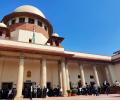
A seven-judge Constitution bench comprising Chief Justice DY Chandrachud and Justices BR Gavai, Vikram Nath, Bela Trivedi, Pankaj Mithal, Manoj Misra and Satish Chandra Sharma said there is no error apparent on the face of the record.

The Supreme Court of India has censured BJP MP Nishikant Dubey for his remarks against the judiciary, stating that his comments "tend to scandalize and lower the authority of the Supreme Court of India." The court dismissed a contempt petition against Dubey but issued a scathing order criticizing his remarks, which included accusations that the court was "taking the country towards anarchy" and that Chief Justice Sanjiv Khanna was "responsible for the civil wars taking place in the country." The court deemed Dubey's statements "highly irresponsible" and indicative of an attempt to "incite religious wars." The order highlighted the importance of maintaining public confidence in the judiciary and condemned attempts to undermine its authority.

The Supreme Court on Friday refused to entertain a fresh plea challenging constitutional validity of the Waqf (Amendment) Act, 2025.
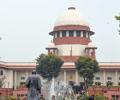
Swamy Shraddananda, jailed for 30 years for killing his wife, has moved the Supreme Court seeking authorities to decide his mercy plea before the President in December, 2023.

A five-judge Constitution Bench headed by Chief Justice Ranjan Gogoi said that even if one per cent chance of mediation exists in the politically sensitive land dispute matter, it should be done.
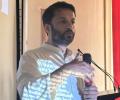
Acting on the Supreme Court's direction, Haryana's Director General of Police Shatrujeet Kapur has constituted a Special Investigation Team (SIT) to investigate two FIRs against Ashoka University associate professor Ali Khan Mahmudabad. The SIT, headed by Additional Director General of Police (Crime) Mamta Singh, will include Superintendent of Police (Karnal) Ganga Ram Punia and Superintendent of Police (STF, Gurugram) Vikrant Bhushan. The SIT will expeditiously complete the investigation and submit a report at the earliest. Mahmudabad was arrested on May 18 for his social media posts on Operation Sindoor, which were alleged to have endangered the sovereignty and integrity of the country. The Supreme Court granted him interim bail on Thursday, but refused to stay the investigation.

The Supreme Court is scheduled to hear a plea on August 8 seeking directions to the Centre for the restoration of statehood to Jammu and Kashmir. The plea highlights concerns about the delay and its impact on democratic rights and development.

The contentious paragraph from last year's verdict, instructing the state to expedite consideration of Meitei community inclusion, was deemed for deletion.
Article 363 bars the interference of courts in any disputes which may arise from certain treaties, agreements, covenants, sanad, engagements, etc., executed between a princely state and the government of India.
The top court said an accused has a right to voluntarily undergo a narco-analysis test at an appropriate stage.

The five-judge constitution bench headed by Chief Justice DY Chandrachud, which heard their contentions at length, told them they will have to justify the procedure adopted for abrogation as the court cannot postulate a situation "where the ends justify the means".

The Supreme Court of India has directed changes in digital know your customer (KYC) guidelines for persons with disability and acid attack survivors, citing the right to digital access as an intrinsic component of the right to life under Article 21 of the Constitution. The court found that existing KYC procedures, which require visual tasks such as head movements and facial positioning, pose significant challenges for these groups, preventing them from accessing essential services like bank accounts and welfare schemes. The court emphasized the importance of bridging the digital divide and ensuring universal accessibility to digital services for all citizens.

As soon as one of the pleas came up for hearing on Friday, Solicitor General Tushar Mehta, appearing for the Centre, objected and said there can't be an "endless" filing of pleas challenging the Act.
'Karur could still impact Jana Nayagan's box-office success if Vijay and the TVK do not get their act together,' points out N Sathiya Moorthy.

The Supreme Court of India on Wednesday said it would consider a plea for early listing of petitions challenging the Centre's decision to abrogate provisions of Article 370 which had given special status to Jammu and Kashmir.

The Aligarh Muslim University's minority status issue will have to wait to reach a logical end after the Supreme Court majority verdict on Friday asked a regular bench to decide the issue.

In a landmark verdict, the Supreme court fixed a timeline for Governor to act on bills passed by the state legislature as it pulled up Tamil Nadu Governor R N Ravi for reserving 10 bills for President's consideration, saying it was against the constitutional provisions.
'Non-BJP state governments and their leaders, navigating today's political landscape, know well they have no clue what awaits around the corner.' 'The chances of charges pressed and oneself getting parked in custody play out on an uneven playing field,' points out Shyam G Menon.

Justice Sanjiv Khanna, who has been part of several landmark Supreme Court judgements such as scrapping the electoral bonds scheme and upholding abrogation of Article 370, will be sworn in as the 51st Chief Justice of India on Monday.
The Supreme Court on Monday directed uniform pension benefits for all retired high court judges, irrespective of their mode of appointment or tenure, saying "one rank one pension has to be the norm in respect of a constitutional office".

The Supreme Court on Tuesday termed as "unacceptable" the submission that Article 370 of the Constitution ceased to operate once the term of the constituent assembly of Jammu and Kashmir ended in 1957 after drafting the state's constitution.
From the beginning of next month, the bench will commence hearing to examine the constitutional validity of the scrapping of the article's provisions and the subsequent presidential orders on it, an official source said.
Not ordering disclosure of details of electoral bonds prior to April 12, 2019, was a "conscious choice" by the Constitution bench, the Supreme Court said on Monday while refusing to entertain the submissions of ASSOCHAM and CII against the disclosure of bond details on the ground of their plea not being listed.

The Supreme Court of India dismissed a plea seeking the inclusion of Vinayak Damodar Savarkar's name in the Emblems and Names (Prevention of Improper Use) Act, 1950. The petitioner, appearing in person, argued for the inclusion based on his 30 years of research and claimed a need to establish facts about Savarkar in a legally verifiable manner. However, the court found no violation of fundamental rights and suggested the petitioner make a representation to the Union of India for curriculum inclusion. This dismissal follows the court's earlier reprimand of Congress leader Rahul Gandhi for his remarks on Savarkar at a rally in Maharashtra, although criminal proceedings against Gandhi were stayed.
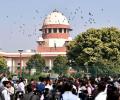
We don't go by either "popular morality or segmental morality" but what the Constitution mandates, the Supreme Court observed on Wednesday when an argument was advanced before it that young same-sex couples across the country wanted to get married.
A bench comprising Chief Justice B R Gavai and Justices Augustine George Masih and AS Chandurkar also directed that the offending video be immediately taken down and restrained the YouTube channel from republishing it or similar content.
The Supreme Court of India has reserved its interim orders on three key issues related to the Waqf (Amendment) Act, 2025, including the power to denotify waqf properties, the composition of waqf boards, and the provision regarding government land. The court heard arguments from both the petitioners, who challenged the validity of the amended law, and the Centre, which defended the Act as a secular concept. The petitioners sought interim orders to prevent the implementation of certain provisions while the court considers the legal challenges.

The bench questioned the petitioner for not moving the high court and directly coming to the apex court.
The Supreme Court on Friday observed the 1976 amendment to the Constitution adding terms 'socialist', 'secular' and 'integrity' to the Preamble underwent judicial reviews and it cannot say whatever Parliament did during the emergency period was all nullity.

The Supreme Court of India has ruled that governors cannot indefinitely delay giving assent to bills passed by state legislatures, setting a timeline of one to three months for their actions. The court said the governor must act "as soon as possible" and that failure to comply with the timeline will make their inaction subject to judicial review. The ruling comes as several opposition-ruled states have accused governors of delaying assent to bills passed by their assemblies.
The Supreme Court of India has reprimanded the Rajasthan government over the alarming rise in student suicides in Kota. The court expressed its deep concern over the situation, questioning the state's efforts to address the crisis. The court also ordered an FIR to be filed in the case of a 22-year-old IIT Kharagpur student who died by suicide in his hostel room, citing a delay in reporting the incident to the police.
